
A suitable PA system is not simply the model with the highest wattage. The right choice depends on what the audience must hear, how the venue distributes sound, how many sources need mixing, and how the system will be operated. This guide turns those requirements into a practical brief for events in Singapore.
1. Start with the event, not the equipment
Begin with the programme. Speech, panel discussions, acoustic music, a full band and DJ playback place different demands on a system. Speech needs clear vocal coverage and enough microphone inputs. Live music adds instruments, monitor mixes and a wider dynamic range. DJ or dance material usually needs stronger low-frequency support.
Write down the audience area rather than relying only on total venue capacity. Include room dimensions, ceiling height, stage position and whether the audience will sit, stand or move between zones. A long room, an L-shaped space or an outdoor audience may need additional loudspeaker positions even when a single pair seems loud enough near the stage.
Room surfaces also matter. Glass, concrete and other hard finishes can produce strong reflections, while curtains and a seated audience absorb energy. Site access, setup time, safe stand positions and cable routes can be as important as the equipment list.
| Question | Why it changes the system |
|---|---|
| Speech, music, DJ playback or a mixed programme? | Changes loudspeaker, subwoofer, input and monitoring needs. |
| Indoor, sheltered outdoor or exposed outdoor? | Changes coverage, weather protection, power and cable planning. |
| Audience area and room shape? | Determines placement and whether delay/fill speakers may be needed. |
| How many microphones, instruments and playback sources? | Sets the minimum mixer channel count and connector requirements. |
| Who will operate the system? | Helps choose between a simple portable rig and a more flexible console. |
2. Choose speakers for coverage and programme
Do not compare wattage alone
Amplifier power is only one specification. Maximum sound level, dispersion, driver size, processing, placement and the listening distance all affect the result. A loudspeaker that covers the front rows well may still leave the back or side of a difficult room unclear. Compare complete published specifications and plan where each loudspeaker can be positioned safely.
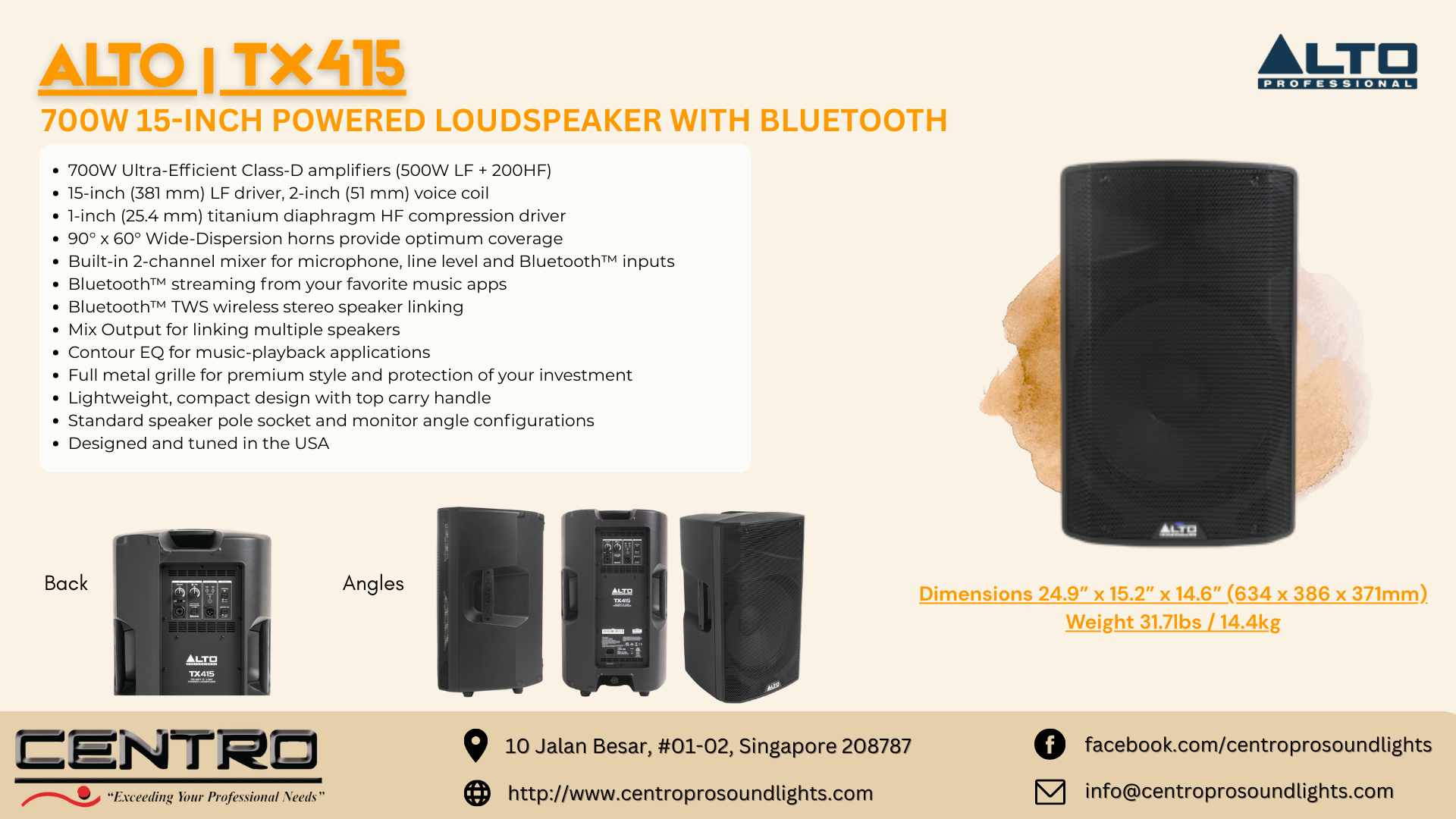
Main speakers are normally aimed at the audience and positioned to reduce direct spill into the microphones. Raising appropriate full-range speakers above audience head level can improve distribution, provided the stand, pole and load are suitable and secured. For a simple portable setup, browse CentroPro’s ALTO TX408 powered loudspeaker and ALTO TX415 powered loudspeaker as examples of different cabinet sizes; confirm the current specification and suitability for your event.
Powered or passive?
A powered speaker contains its power amplifier and can connect to a suitable mixer output, although each cabinet also needs AC power. This can simplify a portable system. A passive speaker needs a separate, compatible power amplifier and speaker cable. Passive systems may suit fixed or expandable designs, but amplifier power and loudspeaker impedance must be matched correctly. Yamaha’s PA speaker guide explains these two arrangements and why impedance matters.
When is a subwoofer useful?
A subwoofer is designed for low-frequency reproduction. It is often useful for DJ playback, dance music, kick drum and bass-heavy programme material; it is not automatically required for every speech event. When a subwoofer is used, the crossover or high-pass/low-pass settings should integrate it with the main speakers instead of making both reproduce the same range inefficiently. The ALTO TX12S powered subwoofer is one catalogue example; ask for compatibility confirmation with the intended main speakers.
3. Plan mixer inputs and outputs before choosing a console
Create an input list: every microphone, instrument, laptop, media player and DJ feed normally needs an appropriate input. Then add sensible spare capacity for a last-minute presenter, playback device or instrument. Count connector types as well as channels—microphone, line and stereo sources are not interchangeable without checking levels and connections.
Outputs matter too. The main left/right feed serves the audience, while auxiliary outputs can create separate monitor mixes for performers or feeds for recording and other zones. A compact speech system may need only a few inputs. A band with multiple vocals, instruments and monitors can require substantially more channels and auxiliary sends.
Analog mixers generally expose controls directly. Digital mixers can provide recall and deeper processing but may need a more experienced operator. Powered mixers combine a mixer and power amplifier for use with suitable passive speakers. Review the audio mixer category and products such as the Yamaha MG12XU; verify input, output and USB requirements against the event brief.
4. Choose microphones around movement, environment and channel count
Wired microphones
A wired microphone offers a direct connection and avoids battery or radio-frequency coordination. It is a practical option when the speaker or performer can remain near a fixed position and a cable can be routed safely. See CentroPro’s wired microphone systems for current catalogue options.
Wireless microphones
Wireless systems help presenters and performers move, but each channel needs a compatible transmitter and receiver, fresh or charged batteries, suitable frequency coordination and a clear operating path. Confirm the approved operating range of the exact model in Singapore rather than assuming that equipment sold for another market uses suitable frequencies.
For several wireless channels, record the number of handheld, headset and lapel microphones separately. Plan spare batteries and perform a walk test at the venue. Browse wireless microphone systems, then confirm current frequency options and availability before ordering.
Reduce feedback through layout and technique
Feedback risk depends heavily on the relative positions of microphones, loudspeakers and reflective surfaces. Keep main speakers in front of open microphones where practical, place monitors in the microphone’s least-sensitive direction, ask speakers to work close enough to the microphone for a healthy direct signal, and mute channels that are not in use. Shure’s live-sound microphone guide explains how source distance, placement and the number of open microphones affect gain before feedback.
5. Plan monitoring, cabling and power
Performers may need monitor speakers or in-ear systems so they can hear themselves independently of the audience mix. Each different monitor mix consumes an auxiliary output and adds setup work. A speech-only event may need no stage monitor; a band may need several. Ask who needs to hear what.
List every signal cable, adapter, power cable, extension and stand. Confirm balanced connections where supported, and keep signal and power routing tidy and protected from walkways. Check the venue’s available circuits and outlet positions; do not assume one convenient wall socket can safely power the complete system. Follow the equipment manufacturers’ operating and power-sequencing instructions.
Schedule a soundcheck with the actual microphones and programme sources. Set input gain so normal peaks remain clean, then balance channels at expected performance level. Yamaha’s band PA setup guide provides a useful reference signal path for mains, subwoofers and monitor sends.
6. Complete the Singapore venue and regulatory checks
- Venue rules: confirm permitted sound levels, operating hours, loading access, stand/rigging restrictions, cable protection and available electrical supply with the venue.
- Outdoor conditions: plan shelter and weather protection appropriate to every device. Do not expose equipment to rain merely because an event is outdoors.
- Wireless compliance: check the exact equipment against current IMDA radio-communication equipment standards and determine whether a licence or exemption applies.
- Event permissions: organisers should check whether the programme needs a Singapore Police Force Public Entertainment licence or qualifies for an exemption. Equipment selection does not replace event approval.
- Backup plan: identify essential spare cables, batteries and a fallback for critical speech or playback.
7. Send a useful brief when requesting a quotation
A detailed brief produces a more relevant equipment recommendation than “PA system for 100 people”. Include:
- event date, setup window and programme schedule;
- venue name, indoor/outdoor status, room dimensions and audience layout;
- speech, music, DJ, performance and playback requirements;
- a complete microphone and input list;
- monitor, recording or additional-zone feeds;
- available power, access constraints and who will operate the system;
- equipment already owned and every required connection;
- preference for purchase options and the budget range.
Ready to compare equipment?
Browse CentroPro’s professional audio equipment, then send the event brief to CentroPro to request current specifications, price, availability and applicable commercial terms.