
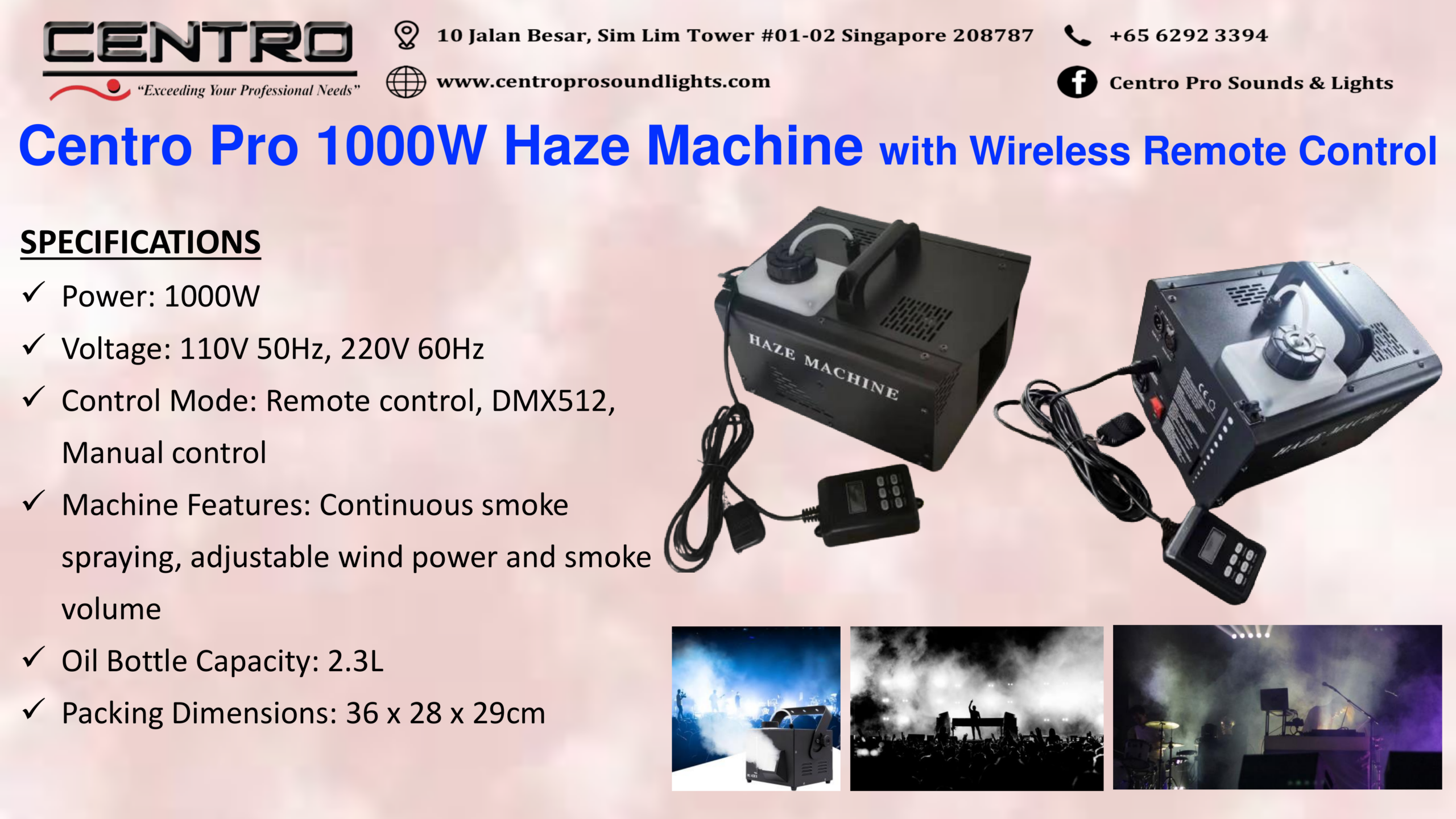
Smoke and haze both make stage lighting more visible, but they create different atmospheres. A smoke or fog machine usually produces a noticeable cloud or burst; a haze machine is intended to distribute a finer, more even atmosphere that can reveal beams without becoming the main visual effect. The right choice depends on the look, venue controls, ventilation, detectors and approved fluid—not only machine output.
Either aerosol can affect venue detectors or policies; approval comes before output.
1. Smoke machine vs haze machine: the quick answer
Choose a smoke or fog machine when the visible cloud is part of the cue—for an entrance, reveal, burst, coloured jet or dense atmospheric moment. Choose a haze machine when the main goal is a thin, relatively uniform atmosphere that helps moving-head beams, lasers and other lighting read throughout a scene.
| Question | Smoke/fog machine | Haze machine |
|---|---|---|
| What does the audience notice? | A visible cloud, plume or burst | A finer atmosphere; usually the beams are more noticeable than the haze |
| Typical output pattern | Intermittent cues or timed bursts | Lower, steadier output distributed over time |
| Common visual use | Reveals, entrances, dramatic jets and dense moments | Beam definition and a consistent lighting environment |
| Planning emphasis | Warm-up, reheat cycle, direction and burst volume | Fan/output balance, time to fill the space and air movement |
| Detector/venue risk | Either aerosol can affect venue detectors or policies; obtain approval before use | |
These are useful categories, not guarantees. Some “faze” machines combine a heated fog generator with a fan to produce a haze-like result. Output density and hang time depend on the exact machine, fluid, settings, room volume, temperature and air movement. Always compare the manufacturer’s documentation for the model and compatible fluid as a system.
2. When to choose a smoke or fog machine
A conventional fog machine heats approved fluid and sends out a visible plume. The effect can make a lighting cue feel immediate because the audience sees both the cloud and any colour or beam passing through it. Vertical machines can direct a jet upward; standard units normally project horizontally. Some models add LEDs, timer operation, remote control or DMX, but those features vary.
Fog is useful for a short reveal, stage entrance, DJ drop, Halloween scene or other moment where a cloud is intentional. It can also reveal lighting beams, though a dense burst may obscure performers, cameras, projection or signage until it disperses. In a small room, even a short output can be visually dominant.
Check warm-up and reheat behaviour. A rated output figure does not mean the machine can necessarily run continuously. Position the outlet so hot vapour cannot strike people, fabrics, scenery or sensitive equipment, and follow the manual’s clearance instructions. Browse CentroPro’s Smoke Machine category and compare a conventional Centro Pro smoke machine with the Centro Pro S-V2 vertical smoke machine; confirm current specifications, controls and fluid compatibility before ordering.
3. When to choose a haze machine
Haze is designed to sit more evenly through the air so light paths become visible without repeated dense clouds. This generally suits concerts, worship, theatre, clubs and presentations where the lighting design should remain readable across many cues. CHAUVET DJ’s haze and fog overview describes the operational difference between a thick high-output fog cloud and a lower, continuously dispersed haze.
A hazer needs time to build and balance. Fan speed, output rate, room size and the venue’s air-conditioning determine how evenly it spreads and how quickly it clears. More output is not automatically better: excessive haze can reduce contrast, disturb sightlines and produce a visible veil on camera.
Noise can matter in speech, theatre, broadcast and houses of worship. Check fan, compressor and pump behaviour at the intended setting rather than assuming every hazer is quiet. The Haze Machine category currently includes the Centro Pro haze machine with remote and DMX operation. Its stored title and specification disagree on power, so confirm the exact rating and all current specifications before ordering.
4. Low fog is a separate effect
Low fog is intended to remain near the floor for a “cloud” effect. It is not simply ordinary haze at a lower setting. Low-fog systems may chill fog, combine water mist with an approved fluid, use dry ice, or use another model-specific method. The result and safety requirements vary greatly.
Consider steps, floor changes, dancers, cables and audience routes: a floor-hugging cloud can hide trip hazards. Condensation or residue may also affect some surfaces. Do not substitute dry ice, carbon dioxide, water or fluid unless the machine’s instructions explicitly call for it. CentroPro’s water-based low-fog machine is a separate catalogue example; verify the operating method, ventilation and exact consumables for the planned venue.
5. Detectors, ventilation and venue approval come first
Atmospheric effects can interact with smoke-detection systems even when the aerosol is not produced by a fire. The response depends on detector type, placement, concentration and airflow. Never cover, isolate or disable a detector yourself, and never assume that “water-based” means detector-safe. Ask the venue manager or fire safety manager for written approval and the required test procedure before bringing fluid into the space.
Provide the machine model, safety data sheet, compatible fluid, proposed position, output direction, cue duration and test schedule. The venue may prohibit effects, limit output, require isolation by authorised personnel under an approved procedure, or require fire-watch and reinstatement checks. Follow its emergency plan. SCDF’s current Fire Code guidance explains that detector selection depends on the processes taking place and that entertainment systems must interface appropriately with fire alarms; it is not permission to alter a venue’s system.
Ventilation changes both the effect and exposure. Strong air-conditioning may clear a plume quickly or produce uneven haze; a stagnant room can accumulate more atmosphere than expected. Start with the manufacturer’s minimum output, monitor visibility and comfort, and stop if people report irritation or if egress signs and routes become less clear. Do not aim output at faces or occupied positions.
For temporary stage shows or a temporary change of premises use in Singapore, organisers should also check whether SCDF’s Temporary Change of Use requirements apply. Venue approval, event licensing and fire-safety permission are separate questions.
6. Choose and handle fluid correctly
Fluid is part of the machine specification. Use only the exact type approved by the manufacturer for that model. Fog fluid, haze fluid and low-fog fluid are not interchangeable merely because they are all liquids. Never add fragrance, dye, oil, alcohol or another flammable substance unless the manufacturer expressly supplies and approves it for the exact machine.
Antari’s Z-350 manual instructs users to place the machine on a level, well-ventilated surface with clearance, use approved fluid and empty the tank before changing fluid to avoid mixing. Read the manual and safety data sheet for the selected product, keep containers sealed and labelled, and prevent contamination entering the reservoir.
Different approved formulations can change density, hang time and intended application. Do not choose only by claims such as “heavy” or “long-lasting”; confirm the manufacturer’s compatibility table. Browse CentroPro’s Smoke and Fog Liquid category and examples such as ANTARI FLG-5E fog fluid. Verify container size, current formulation and machine compatibility before purchase.
7. Plan control, placement and maintenance
Match control to the show. A handheld remote may suit a simple manual cue. Timers can repeat an effect, while DMX can coordinate output and fan settings with lighting cues. Check the channel map, address and available cable type. Wireless remotes are convenient but should not replace a rehearsed stop procedure.
Place the machine level unless its manual permits another orientation. Maintain specified clearances and keep the intake and outlet unobstructed. Protect power/data cables and fluid containers from audience access. Confirm the circuit load from rated input power, not the marketing name alone, and allow the unit to cool before packing.
After use, follow the manufacturer’s shutdown, transport, cleaning and storage instructions. Do not leave old fluid in unsuitable conditions, mix products in a tank or improvise cleaning chemicals. Record the fluid used and maintenance date so the next operator knows the machine’s state.
8. Build a useful atmospheric-effects quotation brief
Include these details when requesting a recommendation:
- venue, room dimensions, ceiling height and indoor/outdoor conditions;
- the intended look: short plume, vertical jet, even beam haze or low-lying fog;
- event schedule, cue frequency and time available to build or clear the effect;
- ventilation/air-conditioning behaviour and camera or projection requirements;
- venue and fire-safety approval status, detector information and test window;
- required manual, remote, timer or DMX control;
- machine position, power availability, transport constraints and approved fluid preference;
- equipment already owned and approximate purchase budget.
Compare the complete effect system
Browse CentroPro’s Stage Effect Machines, then send your venue and cue brief to CentroPro to request current specifications, compatible fluid, price, availability and applicable commercial terms.